How to read odds

Odds represent the likelihood of an event occurring and are commonly used in gambling, betting, and probability discussions. There are three main formats for odds: fractional odds, decimal odds, and moneyline odds. Here's how to interpret them:


1. Fractional Odds (e.g., 5/1, 3/2):

  • How to read:
    • The first number (numerator) is how much you can win relative to your stake.
    • The second number (denominator) is your stake.
  • Example:
    • 5/1: For every $1 you bet, you win $5 (plus your original stake back, for a total of $6).
    • 3/2: For every $2 you bet, you win $3.
  • Calculation of implied probability: this is picture

2. Decimal Odds (e.g., 6.00, 2.50):

  • How to read:

    • The number represents the total return (including your stake) for every $1 bet.
  • Example:

    • 6.00: A $1 bet returns $6 (profit = $5).
    • 2.50: A $1 bet returns $2.50 (profit = $1.50).
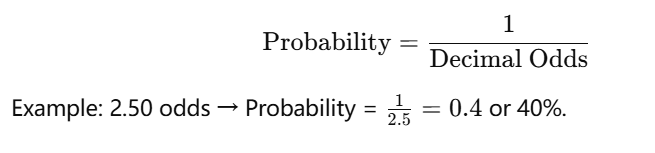
  • Calculation of implied probability:

    this is picture


3. Moneyline Odds (e.g., +200, -150):

  • Positive odds (+): Represent how much profit you'd make on a $100 bet.
  • Negative odds (-): Represent how much you need to bet to win $100.
  • Examples:
    • +200: A $100 bet returns $200 in profit (total payout = $300).
    • -150: You need to bet $150 to win $100 (total payout = $250).
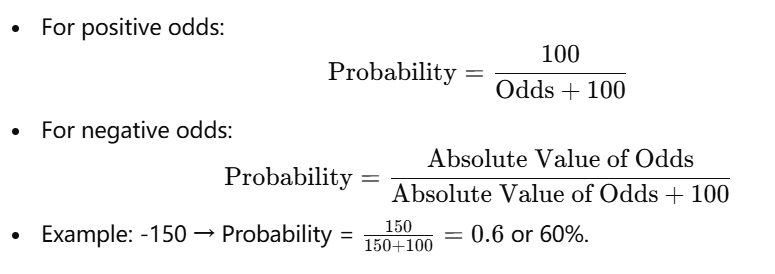
  • Calculation of implied probability: this is picture

Comparison Table

this is picture

| Odds Format | Example | Implied Probability | Profit on $10 Stake | Total Payout on $10 Stake | |--------------|---------------|---------------------|---------------------|---------------------------| | Fractional | 5/1 | 16.7% | $50 | $60 | | Decimal | 6.00 | 16.7% | $50 | $60 | | Moneyline | +500 | 16.7% | $50 | $60 |


If you're betting or analyzing probabilities, understanding these formats ensures you're making informed decisions. Let me know if you'd like more help with examples or calculations!

Double Result
Double Result is a type of sports betting where you predict both the full-time result and the half-time result of a match.
Dime
In sports betting slang, a "Dime" refers to a $1,000 wager.
Dog
a "dog" typically refers to a team or player that is expected to perform poorly, lose, or has little chance of winning the game.
Gamble
refers to placing a wager or bet on the uncertain outcome of a sporting event, with the hope of receiving a potential financial return, while also accepting the risk of loss.
Decimal
In sports betting, decimal odds are a type of odds format commonly used in Europe and Australia. Decimal odds represent the potential return for a bettor, including the original stake. For example, if the decimal odds are 2.50, a bettor who wagers
Home
refers to the team playing at their own stadium or arena, often enjoying the advantage of familiar surroundings and the support of the majority of the crowd.
Novelty betting
It is a form of wagering that involves betting on non-traditional sporting events or entertainment occurrences, such as political elections or television show outcomes, offering a more diverse range of betting options for gambling enthusiasts.
Value bets
Value bets are wagers that have a higher probability of winning than the odds suggest, offering the bettor a positive expected value over time.
point spread
a betting line that handicaps the favorite team by a certain number of points, which they must win by to "cover the spread," while the underdog team can lose by fewer than the specified points or win outright to cover.
outright betting
Outright betting is a long-term bet where the bettor predicts the ultimate winner of a competition before it begins.